Why I Fill the Page Edge to Edge
I began filling the page edge to edge for a very practical reason. Starting felt difficult. Every time I was about to design a new pattern, the beginning felt too big. The blank page held too many possibilities. I would search for the right idea, the right composition, the right starting point.
It slowed me down.
So I started keeping a pattern sketchbook.
Instead of treating each spread as a finished composition, I began treating it as a space for exploration. I would start somewhere and continue. Repeating shapes. Letting one form lead to the next.
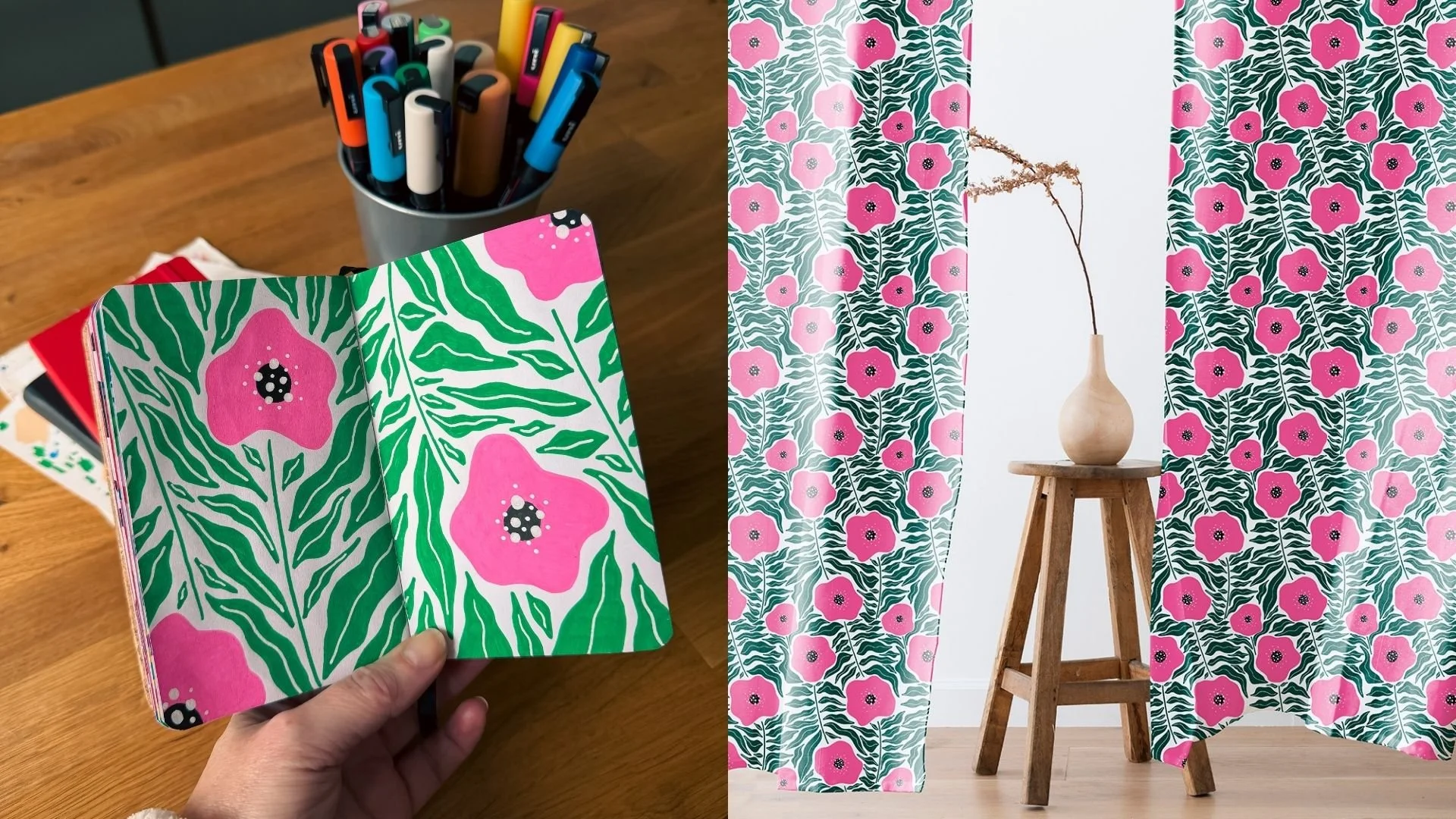
From sketchbook to surface pattern.
Over time, I noticed that I was filling the entire spread — edge to edge.
When I work this way, there is no clear focal point. Nothing has to carry the whole design. The page becomes a continuous surface rather than a framed image. And something shifts in me when the spread is complete. The feeling is similar to finishing a meditation. A quiet kind of satisfaction. The restlessness of the blank page has settled into rhythm.
There is also a sense of pride.
Not because the spread is perfect — but because I stayed with it. Because I transformed a blank space into something structured and alive. This doesn’t mean I am against white space. In design, white space is essential. Some patterns need room to breathe. Some compositions depend on restraint.
But in my sketchbook, filling the page completely serves a different purpose.
Repetition creates continuity. When a motif can repeat beyond the edges of the page, it suggests that it could continue endlessly. The spread becomes a fragment of a larger pattern — part of something ongoing. That sense of repeatability is important to me. It removes the pressure of creating something final. It allows the work to remain exploratory.
My pattern sketchbook is primarily for my own practice. It keeps me in creative flow. It shortens the distance between ideas and action. At the same time, many of the patterns I later develop professionally begin here. They start as quiet experiments, repeated across a page, before they become finished designs.
Filling the page edge to edge helps me move past hesitation. One shape. Then another. Then another. Until the blankness no longer feels intimidating — just transformed.
Each spread becomes its own contained pattern world.
And for a while, I get to spend time inside it.
If you’re curious about the weekly practice, you can join The Pattern Journal here.